Tools




Concepts
What does the term "Six Sigma" stand for
Black Belt Selection & Training
Applications
Does Six Sigma Work in Smaller Companies?
Six Sigma in Information Systems
Six Sigma in Staffing and Employee Relation
Six Sigma application to software projects
Importance of SPC to Six Sigma Projects
Integrating Six Sigma and Related Initiatives
Six Sigma vs. ISO 9001 and Baldrige
Difference between TQM & Six Sigma
Setup Reduction
Setup Reduction is a technique useful for level
load balancing, a key strategy for lean deployment.
Setup Time is defined as
the time to change from the last item of the previous order to the first good item of the next order. Setup includes preparation, replacement, location and adjustment activities (see below). When analyzing setup activities,
note whether the activity is internal or external. Internal setup activities require an inactive (shut down) process, meaning that no orders can be run while the setup activity is taking place. External setup activities may be done
while the process is operational. They are offline activities. Incredible reductions is total setup time have been realized simply by making internal activities external activities. The following four-step approach may be used to reduce
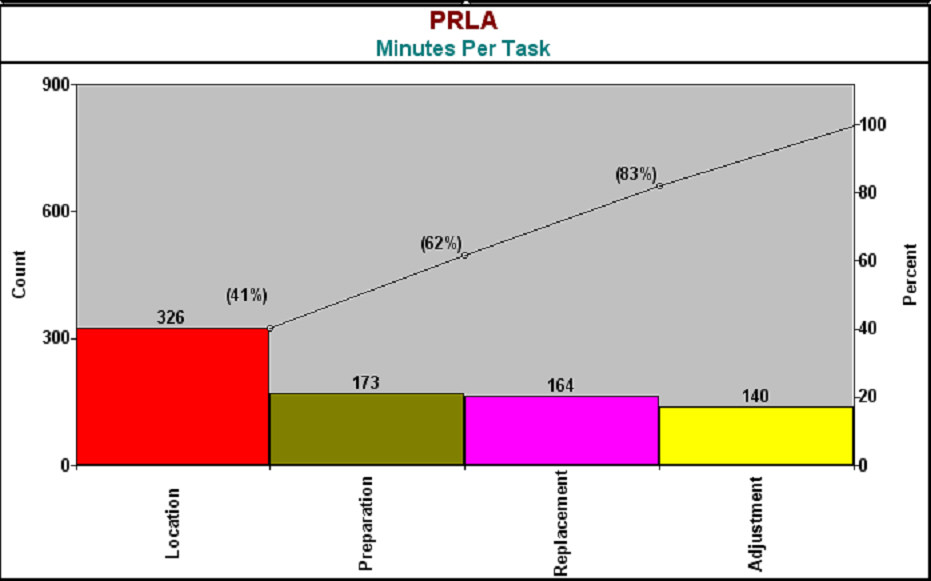
setup times (ref: Lean Six Sigma, by M. George, 2002, McGraw Hill): A Pareto Diagram can be useful to prioritize the setup time reduction. In the example shown, Location dominates the setup, so is a natural target for improvement. A Pareto Diagram to prioritize the setup time reduction opportunities from SPC IV Excel software. Preparation: Preparation refers to the tasks associated with getting or storing tools or WIP needed
for the process. For example, retrieving printer paper from closet; downloading the process instructions on the computer; moving completed items to the next process step; starting-up software that we need to process the order, and
so on. Some suitable actions to reduce the time associated with Preparation include: Replacement: Replacement refers to the tasks associated with adding or removing items or tools. For
example, the movement of test fixtures; loading of new material into the hopper; loading paper in the copy machine. Actions to reduce Replacement times include: Location: Location tasks are those associated with positioning or placement during setup. Examples
include setting temperature profiles for heating; Adjusting cutoff length for specific product; Placing the chunk of deli meat in the slicer. Actions to reduce the time associated with location include: Adjustment: Adjustment refers to tasks associated with ensuring correct process settings. Examples
include Monitoring temperature of furnace; Checking cutoff length; proofing copy before printing. A suitable strategy to reduce adjustment time is process control. If we can improve the repeatability of the process, then the
adjustments would not be necessary. Often this is achieved though robust design methods. Learn more about the Lean Six Sigma principles and tools
for process excellence in Six Sigma
Demystified (2011, McGraw-Hill) by Paul Keller,
in his online Lean Six Sigma DMAIC short course ($249), or his
online Green Belt certification course ($499).