Tools




Concepts
Deming Profound Knowledge & Systems Thinking
Deming on Management of People
Applications
Difference between TQM and Six Sigma
Importance of SPC to Quality Management System Performance
Goal of Quality Cost System
An excerpt from The Handbook for Quality Management (2013, McGraw-Hill) by Paul Keller and Thomas Pyzdek
The goal of any quality cost system is to reduce quality costs to the lowest practical level. Juran and Gryna (1988) present these costs graphically as shown in Fig. 8.3. In the figure it can be seen that the cost of failure declines as conformance quality levels improve toward perfection, while the cost of appraisal plus prevention increases. There is some “optimum” target quality level where the sum of prevention, appraisal, and failure costs is at a minimum. Efforts to improve quality to better than the optimum level will result in increasing the total quality costs.
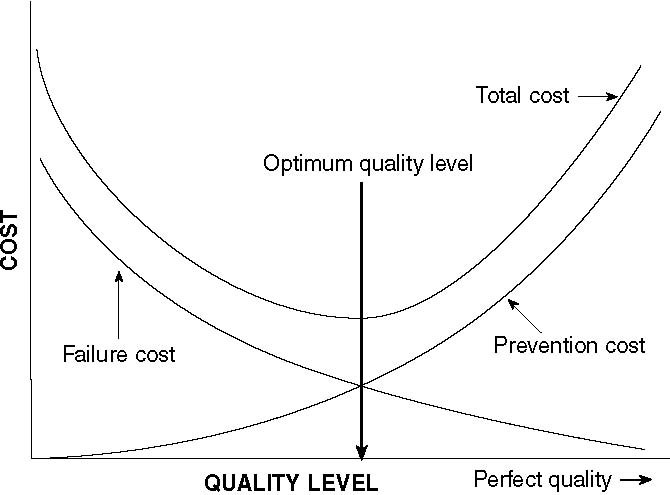
Figure 8.3. Classical model of optimum quality costs. From Jurans Quality Control Handbook, 4th edition. J.M. Juran, editor. Copyright © 1988, McGraw-Hill.
Juran acknowledged that in many cases the classical model of optimum quality costs is flawed. It is common to find that quality levels can be economically improved to literal perfection. For example, millions of stampings may be produced virtually error free from a well-designed and well-constructed stamping die. The classical model created a mind-set that perfection was not cost effective. The new model of optimum quality cost incorporates the possibility of zero defects and is shown in Fig. 8.4.
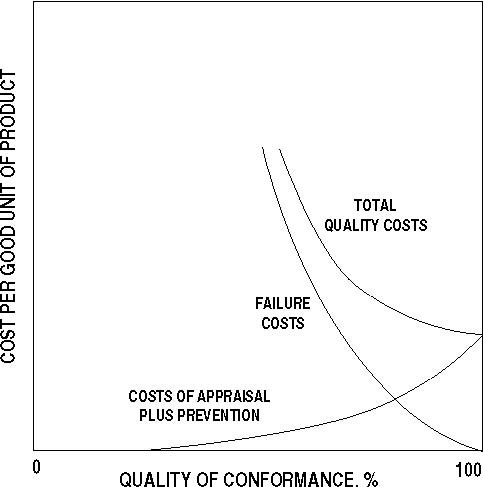
Figure 8.4. New model of optimum quality costs. From Jurans Quality Control Handbook, 4th edition. J.M. Juran, editor. Copyright © 1988, McGraw-Hill.
Quality costs are lowered by identifying the root causes of quality problems and taking action to eliminate these causes. The tools and techniques described in Chap. 5 are useful in this endeavor. KAIZEN, reengineering, and other continuous improvement approaches are commonly used.
See also: Strategy for Reducing Quality Costs for continuation; Cost of Quality Overview for related links.
Learn more about the Quality Management tools for process excellence in The Handbook for Quality Management (2013, McGraw-Hill) by Paul Keller and Thomas Pyzdek or their online Quality Management Study Guide.